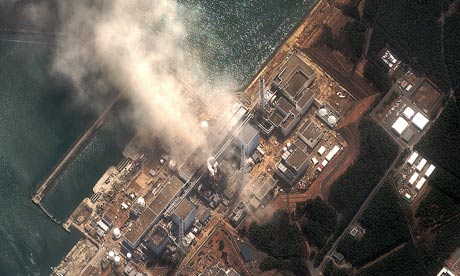
Source: UK Guardian
Date: Thursday 30 June 2011 21.36 BST
by: Rob Edwards
Government officials launched a PR campaign to ensure the accident at the Fukushima
nuclear facility in Japan did not derail plans for new nuclear power stations in the UK.
Photograph: AP
British government officials approached nuclear companies to draw up a co-ordinated public relations strategy to play down the Fukushima nuclear accident just two days after the earthquake and tsunami in Japan and before the extent of the radiation leak was known.
... Read full article here
The following video from KOATV New Mexico (channel 7) reports on the WIPP (Waste Isolation Pilot Plant) 26 miles Southeast of Carlsbad, New Mexico: [1]
Los Alamos National Lab sends some it's nuclear waste here. The 30000 55-gallon drums of radioactive plutonium contaminated waste sitting above ground under cloth tents, as mentioned in various news stories, was/is slated to be delivered to this Carlsbad WIPP site. Quoting the AP:
... The anti-nuclear watchdog group Concerned Citizens for Nuclear Safety, however, said the fire appeared to be about 3 1/2 miles from a dumpsite where as many as 30,000 55-gallon drums of plutonium-contaminated waste were stored in fabric tents above ground. The group said the drums were awaiting transport to a low-level radiation dump site in southern New Mexico.
Lab spokesman Steve Sandoval declined to confirm that there were any such drums currently on the property. He acknowledged that low-level waste is at times put in drums and regularly taken from the lab to the Waste Isolation Pilot Project site in Carlsbad. [2]
...
Thom Hartman's article corresponding to this video reads:
... Kevin Kamps, Nuclear Waste Watchdog at Beyond Nuclear joins Thom Hartmann. If Japan didn't have its hands full with one melted down nuclear plant at Fukushima - it certainly does now with another nuclear power plant on the verge of melting down. About 300 miles southwest of Fukushima sits the Monju nuclear reactor - a prototype fast-breeder reactor filled to the brim with plutonium - the deadliest element on the face of the planet. And last year - a 3 ton device of some sort fell into the Monju reactor blocking access to the nuclear fuel rods in the reactor core - and despite several attempts - has yet to be recovered. Another attempt will be made next week to clear the 3 ton object from the reactor - but critics caution that the procedure is extremely dangerous and could trigger an explosion in the nuclear fuel rods. One ominous sign of just how dangerous the situation is - a top manager at the plant just recently committed suicide. Think of the damaged Monju plant as a nuclear bomb just waiting to go off that could take out the city of Kyoto which is just 60 miles from the plant - and has a population of 1.5 million people. And Japan's largest city Tokyo is downwind from the crippled Monju plant. So what does this all mean? And what's the latest with the two nuclear plants that are in danger right here in the United States - in Nebraska?[1]
...
Since the Thom Hartman interview with Kevin Kamps, the 3.3 ton device they mention was successfully extracted per NHK World in an 8 hour procedure, without incident. 6/23/2011 NHK World
Although it is a relief to hear that no accidents happened as feared with the heavy machinery extraction process, now the Monju reactor can be re-started after a 14 year idle period. Per The Japan Times:
... The agency hopes to resume test runs of the reactor at 40 percent of its output capacity by the end of March, aiming for full operation by the end of March 2014.[2]
...
The original premise behind the operation of the (some would argue extremely dangerous) reactor is recycling nuclear fuel. The drawback is that Monju is cooled with liquid sodium, which back in 1995 caused a serious nuclear accident (fire) with this particular reactor when the sodium leaked out in to open air.
Source: SAFECAST.jp
Date: 6/29/2011
by: Marco Kaltofen
This is a gamma spectrum of dust wiped from a Tokyo rooftop. The detector is located at Worcester Polytechnic Institute’s Physics Department. The results are estimates because of the low weight of dust in the sample. The test found 51 +/- 17 kBq/Kg cesium-134 and 30 +/- 10 kBq/Kg cesium-137. This result is higher than for many soil samples around Greater Tokyo. This is expected since dust samples are less diluted by existing nonradioactive soil material. Not knowing the exact amount of surface area sampled, this measurement can not be directly compared to results given as Bq/square meter.
Gamma spectrum using WPI germanium detector
Almost all of the radioactivity in the sample is coming from cesium isotopes. Just as you would avoid breathing in dusts that contained lead or asbestos, one should avoid breathing in dusts that contain this much radiocesium. Parents are often advised to wash childrens’ hands to avoid ingesting lead in dust. This is also a good practice around dusts that contain radiocesium.
You've heard that potassium iodide helps protect against some types of radiation.
In fact, it only protects against iodine 131 poisoning (and, if not needed, may cause severe adverse reactions in some individuals).
But there are actually different treatments for different types of radiation.
The following chart provided by the Food and Drug Administration summarizes the treatments for exposure to various radioactive elements (click chart for better image):
Prussian blue is taken to minimize damage from cesium. As FDA notes:
The FDA has determined that the 500 mg Prussian blue capsules, when manufactured under the conditions of an approved New Drug Application (NDA), can be found safe and effective for the treatment of known or suspected internal contamination with radioactive cesium, radioactive thallium, or non-radioactive thallium. This decision is based on a careful review of published literature articles containing reports, data, and experiences of people who were exposed to high levels of thallium or cesium-137 and were treated effectively with Prussian blue.
***
Prussian blue works using a mechanism known as ion exchange. Cesium or thallium that have been absorbed into the body are removed by the liver and passed into the intestine and are then re-absorbed into the body (entero-hepatic circulation). Prussian blue works by trapping thallium and cesium in the intestine, so that they can be passed out of the body in the stool rather than be re-absorbed. If persons are exposed to radioactive cesium, radioactive thallium, or non-radioactive thallium, taking Prussian blue may reduce the risk of death and major illness from radiation or poisoning.
DTPA is taken to reduce damage from plutonium, as well as americium and curium. FDA reports:
The FDA has determined that Ca-DTPA and Zn-DTPA are safe and effective for treating internal contamination with plutonium, americium, or curium. The drugs increase the rate of elimination of these radioactive materials from the body.
Sodium bicarbonate plus diuretics (things which increase urine output) may reduce damage from uranium. FDA notes:
Uranium contamination has been treated with oral sodium bicarbonate, regulated to maintain an alkaline urine pH, and accompanied by diuretics. Oral sodium bicarbonate has not been approved in the United States for this indication.
Sodium bicarbonate is baking soda. While I have no idea whether it is true or not, many alternative people advocate bathing in baking soda after being exposed to uranium.
Note: I am not a medical professional and this does not constitute medical or health advice. This is for general informational purposes only. Some or all of the above-described substances may have severe side effects or - if used improperly - may cause more damage than they prevent. Don't take any of these preventatively ... only if exposed to high levels of radiation. Consult your doctor before taking any of the above medicines.
Source: Democracy Now (I extracted the relevant video segment for relevance/brevity)
Date: 6/28/2011
The following Democracy Now interview with Greg Mello, leader of Los Alamos Study Group, not only warns that the Los Conchas wildfire in New Mexico threatens nuclear waste stored on the grounds of the Los Alamos National Laboratory, but also sheds light on the fact that the Obama administration is actually increasing nuclear weapons production/upgrades. I knew that Obama was an advocate of nuclear power for energy production but did not realize he was actually working towards increasing/upgrading America's current nuclear weapons arsenal. As part of this effort, Los Alamos National Lab will build a new $6 billion facility for the production of plutonium.
I thought it would be informative to overlay this map with a map showing the technical areas (TAs) and material disposition areas (MDAs) on the Los Alamos National Lab reservation. Check this out:
As far as the MDAs go, the fire is closest to MDA-R, MDA-S, MDA-Z and MDA-AB. These contain various toxic metals, organics, high explosives and radioactive wastes mostly buried in pits.
All of those 30,000 drums of low-level radioactive waste we have been hearing about are in MDA-G, which is further away from the fire at the moment.
But, oddly, what we haven't heard much about is the storage site for transuranic waste which is in MDA-C. This one is a little scary. Here is the description from the LASG site:
------------------------------------------------
[link to www.lasg.org]
Location: Technical Area (TA) -50
Period of use:
Pits (6): June 1948 to December 1964
Shafts (107): 1958 to April 1974
Size: 11.8 acres
Number and type of disposal units:
Pits 1- 4: 610 by 40 feet
Pit 5: 705 by 110 feet by about 18 feet
Pit 6: 505 by 100 feet by about 23 feet
Chemical pit: 180 by 25 feet by about 12 feet
Vary between 1 to 2 feet in diameter, and 10 to 25 feet deep
Specific wastes and quantities:
Estimated Volume: 3,186,000 ft3 of TRU waste
Pits contain, as of January 1973:
25 Curies (Ci) of uranium
26 Ci of plutonium-239
149 Ci of americium-241
Shafts contain:
49,136 Ci of tritium
40 Ci sodium-22
20 Ci of cobalt-60
31 Ci of strontium-90
5 Ci of uranium-233
50 Ci fission products
200 Ci of induced activity
Also contains quantities of mercury, copper, cobalt, boron, beryllium, and silver. (2)
Potential environmental impacts:
Lies near Ten-Site Canyon New Mexico Environment Department's (NMED) Hazardous and Radioactive Material Bureau (HRMB) ranks this MDA as an area with a high probability of contaminant mobilization and a moderate to high potential of release to the groundwater.
--------------------------------------------------
That is an insane amount of highly radioactive waste. And notice at the end there that it is ranked as HIGH probability of contaminant mobilization!
Just a heads up for you guys. We really need to watch this thing!
Source: NHK World
Date: Wednesday, June 29, 2011 08:36 +0900 (JST)
The Japanese government plans to help Fukushima Prefecture conduct health research for all local residents with estimates on the spread of radioactive substances from the Fukushima Daiichi nuclear plant.
... Read full article here
Source: NHK World
Date: Wednesday, June 29, 2011 15:28 +0900 (JST)
The operator of the Fukushima Daiichi nuclear power plant restarted its new reactor cooling system on Wednesday after fixing faults in the hosing.
... Read full article here
Angry shareholders lashed out at Tokyo Electric Power Co. on June 28, demanding a retreat from nuclear power and the chairman's resignation over the crisis at the Fukushima No. 1 nuclear plant.
But at the end of the TEPCO shareholders' meeting, attended by a record number of people, motions to cease operations and decommission reactors were voted down, and Chairman Tsunehisa Katsumata retained his post.
... Read full article here
Date: 6/28/2011 sampling video captures 2-3 minutes starting approximately 2:10 PM CST
This is somewhat disturbing. I noticed that the Driggs, Idaho Ustream meter, which can be observed in real time by clicking the "USA" link on the navigation bar at the top, has spiked up to as high as 140 CPM (counts per minute). Per the Geiger counter owner, normal background radiation is 20 CPM. 140 CPM is thus 7x background, although 140 is an extreme and not average sampling value. On the CerebralProgrammer Ustream site for this Geiger counter notes included:
... Station Log:
6/27/11 Significant increase detected in gross beta gamma levels. System tests provide normal results. Radon levels are down currently and not correlative to increased beta / gamma.
...
A few days ago on June 24, 2011 I captured another 2 minute or so sampling at around midnight showing a CPM from the same meter as high as 100 CPM.
The closest EPA RadNet monitoring site to Driggs, Idaho is in Idaho Falls, Idaho which is 49 miles away in a straight line per the graphic below:
The EPA RadNet monitoring station is 40 miles East of Idaho National Lab, which is one of the nation's first nuclear test sites. Plutonium contaminated nuclear waste from nuclear weapons manufacture is stored on the grounds. Activist groups have long battled for cleanup of nuclear waste at the facility, siting that much of it sits on top of the Snake River Aquifer. Radioactive waste is shipped in to Idaho National Lab from other facilities for treatment and storage.
The EPA gross gamma and beta counts do not really show any unusual spikes in recent activity if examining the RadNet monitoring station data from Idaho Falls:
If there (hypothetically) is recent unusually high radioactive fallout blowing in to Driggs, Idaho from the Idaho National Lab nuclear waste dump(s) you would expect the EPA air monitoring station to pick up on it since Idaho Falls is only half the distance to INL as Driggs (where CerebralProgrammer's Geiger counter is located) is to INL (see previous geographic map).
Also the wind is not blowing due East, but rather the most recent wind forecast I obtained shows the wind is blowing primarily from South to North, with a slight Northeast angle:
If the elevated radiation reading shown at Driggs, Idaho really is coming from Fukushima (as one would naturally expect), for example, this would require a detailed isotope analysis by a nuclear expert to prove it really is from Fukushima. Unfortunately, in May the EPA discontinued much of its testing of radioactive isotopes as per OpEd News:
... The EPA announced in early May that it would cease testing air, rainwater, tap water and milk, as iodine 131 levels, the isotope with the shortest half-life, had fallen to normal atmospheric levels (EPA test results here). It has been reported at several websites that both NILU and the EPA were pressured to discontinue testing -- or at least to discontinue publication of the test results. The "pressure" has been variously attributed to the U.S. government, the Japanese government and the United Nations, although I have seen no hard evidence to substantiate any of those claims.[1]
...
There is a petition started by Lucas Whitefield Hixson which requests that the President, Congress and EPA reinstate the radioactive isotope testing as mentioned above. If you have not signed it already, the petition is available here.
Any comments or tips (especially from nuclear experts) would be appreciated.