Source: UK Guardian
Date: Wednesday 13 July 2011 19.20 BST
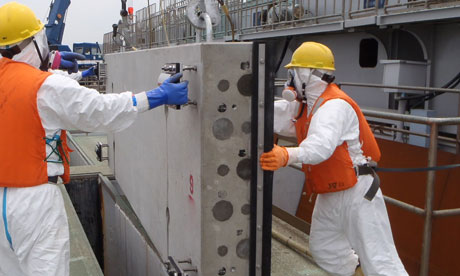
Fears grow for inexperienced contractors working in Japanese heatwave to bring stricken nuclear reactors under control
Workers at the Fukushima Daiichi nuclear power plant. Photograph: Ho/AFP/Getty Images
Hundreds of inexperienced contractors at the Fukushima Daiichi nuclear plant are working in searing heat and high radiation levels for as little as 10,000 yen (£80) a day.
... Read full article here
The video below goes over the shocking lab radionuclide test results of soil taken from a Tokyo playground which a private Japanese citizen payed for with their own money:
For reference, the following chart taken from Bloomberg shows safe food and water limits set by the Japanese government:
================================================================
Prescribed safe limits for radioactive Iodine-131:
================================================================
300 Becquerel per kilogram         Drinking water
300 (Bq/kg)                        Milk, dairy products
2,000 (Bq/kg)                      Vegetables*
                                   (*Except root vegetables and
                                   tubers)
================================================================

================================================================
Prescribed safe limits for radioactive cesium:
================================================================
200 Becquerel per kilogram         Drinking water
200 (Bq/kg)                        Milk, dairy products
500 (Bq/kg)                        Vegetables
500 (Bq/kg)                        Grains
500 (Bq/kg)                        Meat, eggs, fish, etc.
================================================================
Prescribed safe limits for uranium:
================================================================
20 Becquerel per kilogram          Infant foods
20 (Bq/kg)                         Drinking water
20 (Bq/kg)                         Milk, dairy products
100 (Bq/kg)                        Vegetables
100 (Bq/kg)                        Grains
100 (Bq/kg)                        Meat, eggs, fish, etc.
================================================================

================================================================
Prescribed safe limits for alpha-emitting nuclides of plutonium
and transuranic elements:
================================================================
1 Becquerel per kilogram           Infant foods
1 (Bq/kg)                          Drinking water
1 (Bq/kg)                          Milk, dairy products
10 (Bq/kg)                         Vegetables
10 (Bq/kg)                         Grains
10 (Bq/kg)                         Meat, eggs, fish etc.
================================================================
Further testing will be done on the soil sample at a second lab, for other radionuclides.
Also, the above video illustrates that when placing a personal dosimeter (Geiger counter) right on the ground in Kashiwa, which is 23 km from the center of Tokyo, the measurement is astonishingly high showing a peak of 6.59 μSv/hr (microsieverts/hour). For reference, there is only one personal dosimeter shared on Ustream (that I could find), which consistently shows values in whole numbered μSv/hr. This is the GM-fukushima Geiger counter, which normally displays the outdoors levels of an open air cafe in Iitate Village, Fukushima Prefecture. This is the closest Geiger counter in the Live Streaming Radiation Meters collection to the Fukushima Daiichi nuclear power plant.
Source: examiner.com
Date: 7/13/2011
by: Alexander Higgins
52,547 Bq/Kg of of Cesium radiation measured in soil samples collected just outside of Tokyo over 135 miles south of the Fukushima nuclear power plant.
A reader from Japan has sent me a copy of his official Lab results for nuclear radiation soil samples collected in Kashiwa, Japan, which is on the outskirts of Tokyo and over 135 miles south of the Fukushima nuclear reactor. The lab results show that 52,547 Becquerels Per Kilogram Of Cesium Radiation was found in the sample. 23,663 Bq/Kg of Cesium 134 radiation was found. 28,884 Bq/Kg of Cesium 137 was detected.
... Read full article here
Source: The Japan Times
Date: 7/13/2011
by: REIJI YOSHIDA and TAKAHIRO FUKADA Ground zero: Bulldozers (top) take the top off a 35-meter bluff to prepare the site for the Fukushima No. 1 nuclear plant in the late 1960s in this image taken from the documentary "Reimei" ("Dawn"). Left: The construction site is seen after the leveling work. Right: An excavated area where the emergency diesel generators were installed is seen at the construction site. TOKYO ELECTRIC POWER CO.
First of Two Parts
The March 11 monster tsunami that hit the Fukushima No. 1 nuclear plant destroyed the critical backup power system and triggered the meltdown of hundreds of fuel rods in reactors 1, 2 and 3.
Video of the appalling damage and reactor building explosions led many — from regular people to nuclear and quake experts — to ask: Why wasn't the coastal nuclear plant built in a location safe from all tsunami threats?
... Read full article here
TOKYO, July 13 (Reuters Life!) - A substitute on the Japanese women's national soccer team who led her country to its first ever World Cup semi-final appearance counts among her supporters workers battling to bring under control the world's worst nuclear crisis in 25 years.
Not surprising, perhaps -- some are former colleagues from when Karina Maruyama herself worked at Tokyo Electric Power Co(Tepco), the operator of the nuclear plant crippled by the March 11 earthquake and tsunami.
The 28-year-old Maruyama has become a national heroine after coming off the bench to score an extra-time winner against the heavily favoured defending champion Germany on Saturday.
Her dramatic 108th minute goal gave Japan a 1-0 win over Germany and brought an outpouring of praise and gratitude on her blog, but it was a former colleague now working to contain damage at the Fukushima Daiichi plant 240 km (150 miles) from Tokyo who really moved her.
... Read full article here
Here is the goal made by Karina Maruyama, former TEPCO employee
The data is not new, but what this report illustrates is the under-reporting (or non-reporting) of dangerous radiation levels.
The nuclear industry and nuclear regulators worldwide, as well as specifically in the United States, have continually covered up disasters and radiation releases as if they never happened or posed no danger to the public.
To begin to understand the corruption of the nuclear power industry and the danger we are in because of it, you must first realize that they actually fund their regulators, The NRC in the United States and the IAEA for the world.
... Read full article here
The radiation tainted beef from a Minamisoma City farm made it out to at least 11 prefectures including Tokyo and Osaka, and some of the radioactive beef has been consumed.[1,2] As per the Japan Times:
... The farm shipped the six cows between May and June, according to the Tokyo Metropolitan Government. Their beef was distributed to Tokyo and Shizuoka, Osaka, Kanagawa and Ehime prefectures. It was also distributed to dealers in Hokkaido, Aichi, Tokushima and Kochi.
According to Aichi Prefecture, 5.9 kg of meat was shipped to a grill eatery in the prefecture from a Tokyo processing plant and 3.15 kg of that meat had been consumed.
Hokkaido said one cow's worth of meat was consumed in a restaurant in Chitose.
The meat was also sold at a supermarket chain in Tokushima and Kochi prefectures.[2]
...
Typically local governments are expected to do testing and ensure food safety. Previously, only the radiation level on the outside of cattle was checked, which means that, hypothetically, if the outside of the animal had been scrubbed clean it could have passed the inspection even if the meat itself exceeded the 300 becquerels/hour safety limit. The amount of beef able to be tested is about 1 percent of the total. However, the ministry of agriculture just recently launched its own testing of farms in Fukushima Prefecture, which will include all farms (the total number is about 260) which raise beef cattle and are in evacuation areas.[2]
The radioactive beef in the news lately is actually sourced from a single farm in Minamisoma City, which is near the Fukushima Daiichi nuclear power plant, but outside the government mandated exclusion zone.
Here is how the radioactive beef propagated per NHK World:
... Above normal levels of radioactive cesium have also been found in 11 other head of cattle from the same farm after they were brought to a slaughterhouse in Tokyo.
Officials of Shizuoka City, more than 300 kilometers from Minamisoma City, say a meat-packing company bought 27 kilograms of the beef on June 10th.
13 kilograms have already been sold to restaurants in the city. In an inspection, Shizuoka City detected 1,998 becquerels of radioactive cesium per kilogram, 4 times higher than the government's standard.
The remainder, 14 kilograms of beef from Minamisoma was purchased by a meat dealer and sold by retailers or consumed at restaurants.
Tokyo, Kanagawa and 3 other prefectures also have found that meat from 6 head of cattle raised by the same producer was sold to some local dealers.[1]
The radioactive beef was detected as having more than triple the legal limit of radioactive cesium contamination.[2] The farmer kept his cattle inside, but when he ran out of feed he fed them radioactive hay which had been sitting uncovered outside and was exposed to the fallout from Fukushima Daiichi. The radioactive straw itself was found to have radioactive cesium at 75,000 becquerels per kilogram. I have seen two conflicting figures as to what the safe limit is for radioactive cesium. NHK World says it is 300 becquerels/kilogram. Kyodo News says 75,000 becquerels/kg is 56 times the safe limit (e.g. 1339.29 beqeurels/kg if plugging the numbers in to a calculator). [2, 3]
What stuck out as a sore thumb from the video is that only the outside of the cattle is being measured for radiation, not the internal levels of the beef.
Residents from two areas of Minamisoma where radiation levels were found to be at least 20 millisieverts/year are also being screened presently for internal radiation levels. Although Minamisoma City is outside the Fukushima evacuation zone, it appears to be a radiation hot spot.
Nuclear engineers Arnie Gundersen and David Lochbaum discuss how the US regulators and regulatory process have left Americans unprotected:
The well-known safety flaws of Mark 1 Boiling Water Reactors have gained significant attention in the wake of the four reactor accidents at Fukushima, but a more insidious danger lurks. In this video nuclear engineers Arnie Gundersen and David Lochbaum discuss how the US regulators and regulatory process have left Americans unprotected. They walk, step-by-step, through the events of the Japanese meltdowns and consider how the knowledge gained from Fukushima applies to the nuclear industry worldwide. They discuss "points of vulnerability" in American plants, some of which have been unaddressed by the NRC for three decades. Finally, they concluded that an accident with the consequences of Fukushima could happen in the US.
With more radioactive Cesium in the Pilgrim Nuclear Plant's spent fuel pool than was released by Fukushima, Chernobyl, and all nuclear bomb testing combined. Gundersen and Lockbaum ask why there is not a single procedure in place to deal with a crisis in the fuel pool? These and more safety questions are discussed in this forum presented by the C-10 Foundation at the Boston Public Library. Special thanks to Herb Moyer for the excellent video and Geoff Sutton for the frame-by-frame graphics of the Unit 3 explosion.
Source: Alexander Higgins Blog
Date: July 10, 2011 at 11:02 am Japan’s prime minister has finally admitted the to the reality of the Fukushima nuclear disaster, labeling the nuclear meltdowns as the new Chernobyl and admitting it will take decades before the nuclear disaster is cleaned up.
As previously reported, Japan’s new timeline for cleaning up the nuclear meltdown is at least 10 years from now and that is contingent on technology being developed within that time to allow workers to cleanup the molten fuel at the nuclear reactor.
... Read full article here
The Geiger counter in the video is set to measure mR/hour (millirads/hour). Multiply the reading by 10 to get μSv/hr (microsieverts/hour). The readings in the video peak out at .320 mR/hour, or 3.2 μSv/hr. For perspective, only one Geiger counter in the collection of meters from Live Streaming Radiation Meters gets to whole numbers typically. This is the GM-fukushima meter situated in an outdoor cafe in Iitate Village, Fukushima Prefecture, Japan which is the closest meter in this collection to the Fukushima I nuclear power plant.
Video Description:
All Rights Reserved, (c) 2011 www.POTRBLOG.com
We got stuck next to this truck during the 7pm July 1st holiday traffic on North bound I-270, after seeing the Radioactive warning placards we pulled out the Geiger Counter and Camera. Lesson learned, AVOID RADIOACTIVE TRUCKS!
The Geiger counter samples over a 30 second moving average, updated every 3 seconds. Notice how the reading on the Geiger Counter keeps moving upwards after we pass the truck; had we stayed next to the radioactive truck the readings would have went even higher.
Pray for the truck driver; the source of gamma rays appeared to be located almost directly behind the driver. One would think that these things would be much more heavily shielded, located further away from the driver, and that such materials would be transported when other people are not on the road.
The truck exited I-270 at Lilac Ave.
Did you ever accidently step into a bear-trap, while walking in the woods?
I’m an artist. My wife and I live in small town, Ontario, Canada. On March 11th 2011 I was happily working on a portrait of two darling young sisters, when the earth shook in Japan. I put down my brushes, and went to the computer to investigate. I haven’t been back to my portrait, yet. The Jaws of Fukushima had me.
The media kept concentrating on the earthquake and Tsunami, saying very little on the condition of their reactors at several nuclear plants. It soon became apparent that the reactor:”Fukushima 1”, was in the most trouble.
The 4 explosions at the reactors and spent fuel pools came next, but we have only been shown film of reactors number 1 and number 3 exploding. Film of explosions at reactors number 2 and 4 have never been released to us “the public”. There have been problems with reactors 5 and 6, but the state of danger is unreleased. We stocked up on food, water and other supplies.
... Read full article here